

Microslop. There, we did our part!
This article will more than likely buy us a blacklist on the Bing network. For those people younger in the crowd, asking, "What's a Bing?" Ohh, bless you, child, for nature is healing.
First, a special thanks to the PCMasterRace thread on Reddit for the graphic and credit to SaucyStrawberries, ITXEnjoyer, TheClone_, and PCLover2 for the revised title you are seeing above this site. We know that you guys gave full permission to use this logo. But we still like to give credit where it is due!
Want to know the wonders that are Microslop and A.I. from randos on the net? And what are we doing about it? MY! You've come to the right place. Read on if you want to hear more!
Microsoft's Satya Nadella wants you to stop saying AI "slop" in 2026
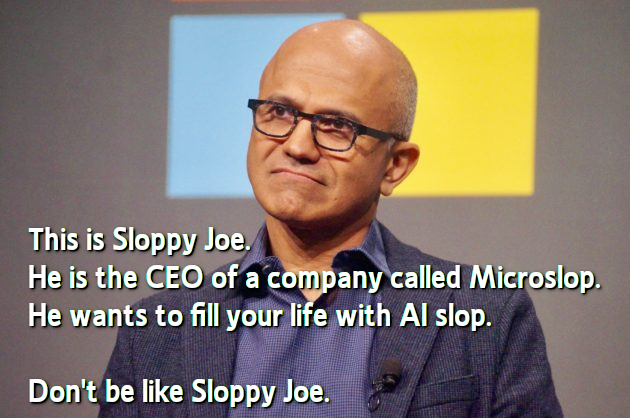
The king of slop has spoken.
One of the many mistakes the sadder, uncool cousin of Mr. Clean has made is telling the Internet what it can or cannot say. As if he believes he can threaten people on the net as if we were one of his employees.
Yeah, that's not going to work.
But there's a bigger problem than just a delusional CEO guy who built up their Azure server division and ultimately wants you to commit to their rental cloud using inferior video products like Teams that record at 720p, despite buying Skype and Mixer, which offered far superior 1080p streaming. Or, painful cloud storage synchronization systems like OneDrive which may or may not sync everything in a folder. It's also shoving Tay, no wait, Cortona, oh fuck, Copilot too hard, they have to replace one of their flagship products, "Office 365" with "Copilot 365" just to show the world:
Everyone loves AI! See! Everyones using it! Even to search for files. Which originally was done with dir /s. But now with 40x more computing power is required to do the same job! - Microslop
Personal time.
As we are talking about history, we shall refer to post-slop "Microsoft," where, during our many years of working in IT, the operating system has certainly given us a career with all of the twisting maneuvers this company has done since Y2K. forcing everyone off of Windows 3.1 and into Windows 98. We never really hated Microsoft. It played our games. And gave us a reasonable platform for business, gaming, and creativity. The number one reason why people stick with this OS and people still believe in Microsoft is that it gave people careers (unless you were one of the lucky few who were in a business that used Macs for graphics or a non-profit that then took the time to switch to Linux.
Windows 98 made no sense to us, so we switched to Windows 2000, which quickly became our daily driver. eventually, Windows XP arrived, offering better hardware codec compatibility when playing higher-resolution videos. Then came Windows 7, which phased out 32-bit processors, prompting a small percentage of those users to switch to Linux distros that are still being updated, such as Void Linux. Windows Vista was released, which introduced the tiling system that no one wanted. Microsoft took a step back and eventually gave us Windows 10, which, to us, was the longest-running OS we've ever used.
Windows 10
Over the course of Windows 10, we noticed that all of these updates, security patches, and everything turned a system that ran with 1-2GB of RAM into almost 4GB of RAM while running an average amount of background process utilities. Programming became worse as simply utilities like turning on the fans on your motherboard required almost 2 GB of RAM alone just to run because it's built on the front-end of browsers. Speaking of the browser in Windows 10, this is one of those moments where the browser and the operating system are inseparable. You cannot uninstall Microsoft Edge or Internet Explorer without causing some kind of serious failure because this is how they were going to control the internet, which is by forcefully making the end-user use their browser and not Firefox or Google.
This would be about the time we left the IT Industry. Because IT was originally supposed to assist and educate the business on how to be better with their computer. In most companies, IT was used as a weapon by upper management to be a Gestapo against their employees by monitoring what they are doing and writing people up for not following a tyrannical police that stifled innovation in many work environments around the United States, if not the world.
Also in the background, Microsoft has been quietly purchasing advertisement agencies like the old Bonzai Buddy program. In general, it starts filling its programming roster with companies that do not respect the privacy rights of its end-users, only for it to show its ugly head with Windows 11.
Windows 11
It wasn't just key generators we relied on, like in previous operating systems, to make Windows 11 remotely usable for us. It was programs such as Rufus(clear-net) that transferred ISOs to USB sticks that offered other mods, such as disabling TPM, memory, and processor restrictions.
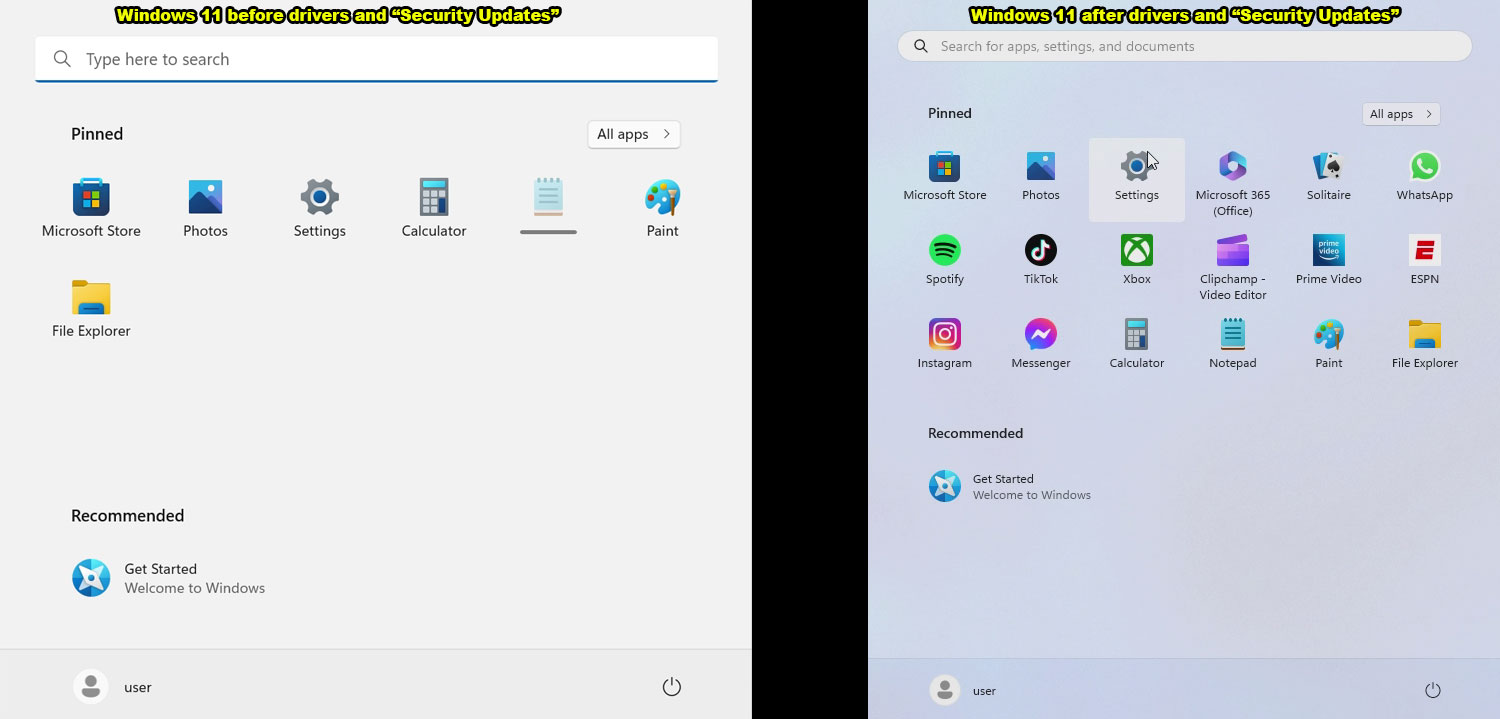
As discovered back in our thin-client blog. It was finding out that even after Rufus was installed. That the supposed security updates that Microsoft gave you weren't really security updates at all, but just advertisements for apps you didn't need or didn't want. Eventually, Edge and CoPilot were installed and couldn't be removed. Which, if you were to describe a program that installs itself on your operating system, unwanted and cannot be removed. That's malware. And no, it wasn't because of the keygen software or Rufus. This software was coming directly from Microsoft.
In which we have to feel bad for anyone attempting to join the information technology industry, knowing the enemies that we fought in the mid-2000's are now 'Microsoft affiliated partners' in 2026.
Now, there is good software to try and combat this. Such as Windows Deboater. Which works up until the point you set up a new user on your OS in which, during the profile setup wizard, it will redownload all of the garbage you wanted gone from your OS in the first place.
Windows 12
Hasn't really come out yet. It's all speculation. But given that the Windows operating system only makes up 20 percent of Microsoft's profit, there is absolutely no reason to cater to users. So it will be likely that it will be a subscription service. There may even be a requirement that your system needs to have a TPU as well as the TPM so that Microsoft can use your own hardware against you to push their CoPilor AI agenda. Which Microslop seems to want CoPilot to consume every one of their products? There's not even 'OFFICE' anymore! Just CoPilot 365. Microslop will make you use their AI by force if they must.
Time to be real.
We have to redact our statement at the beginning. We do hate an operating system now. Because in the past two years, Microslop went out of its way to make us hate it. An uncontrollable nightmare that installs background tasks like "Microsoft Recall" to spy on every single thing you do. An operating system that doesn't even respect administrative power to remove something because to Microsoft, they don't even trust people with domain admin access to delete, unless you have to jump through a series of PowerShell scripts to attain ownership, as you type of these horrid commands we're questioning the whole point of being an administrator when you can't even admin your own machine.
We're tired of big tech's shit. We will not subscribe to the concept of "You will own nothing and like it." Nor do we expect Microslop to bend the knee to a person who was hardly a customer, either. In fact, to the people who supported their empire and made a living doing so. Satya Nadella would rather see us dead somewhere on the side of the road.
Business is never a democracy. Firefox proved this by opening a town hall meeting about AI, then flipping everyone the finger and deploying AI anyway. When we were still in the information technology business, we played with them all. Just to give you a bit of a summary:
- The Ouya, for as much of a joke game system as it was, taught me A LOT about how the Android OS worked.
- Raspberry Pi, OpenWRT, and DD-WRT taught me a lot about Linux operating systems on alternative CPUs.
- Red Hat Linux was the first time we managed to get Quake 3 working on an HP Vectra 7 using an ATI Rage card.
- We've done video editing work on an OS X Mac. It was nice! Liked the fact that even if you used 100 percent CPU, the OS was still usable. Seriously, we wish we could afford Apple tech, but life has never dealt us that kind of hand of being rich, as we've only borrowed Apple tech. Never owning.
ERROR - Out of RAM.
As almost an icing on the cake, you have a major finger-pointing game from the chip manufacturers, saying that they just can't keep up with AI's demand for memory, which is a thinly veiled translation for price fixing. Why sell to the open market $100 for a stick of RAM when an excuse that is free can earn you three to six times that amount? Why not fuck over the market now that you exist in a country where price fixing is totally cool to do to others, as long as you don't fuck with the local government?
Another attempt to detract ownership of a product and instead lease or rent from the datacenters that started this in the first place.
Now, lucky us. People who still repair hardware are the technical equivalent of being a vulture. We will always own our own tech because this is tech that others threw away. Eventually, there will be a datacenter crash, or a 'security update' that will make companies trash hundreds of thousands of dollars of gear. And you bet your ass we'll be there to pick it up. Of course, they'll make it harder with TPM locking down everything. But there will always be a way. If this paragraph sounds like something that comes from the Cyberpunk Mantra "High tech, low life," well, let's just say American society loves spewing forth the Star Trek future but ramming the Mad-Max/Idiocracy one straight up our asses.
What to do.
Anger, unlike depression, is motivated and focused. You don't cry about something and then do nothing. That's depression. Instead, you find a solution. This blog tries to strive for solutions when we point out problems. We don't want to depress the living shit out of our readers. But this one is a bit difficult to solve because it requires a bit of personal investment and conviction. What was my personal investment, you may ask?
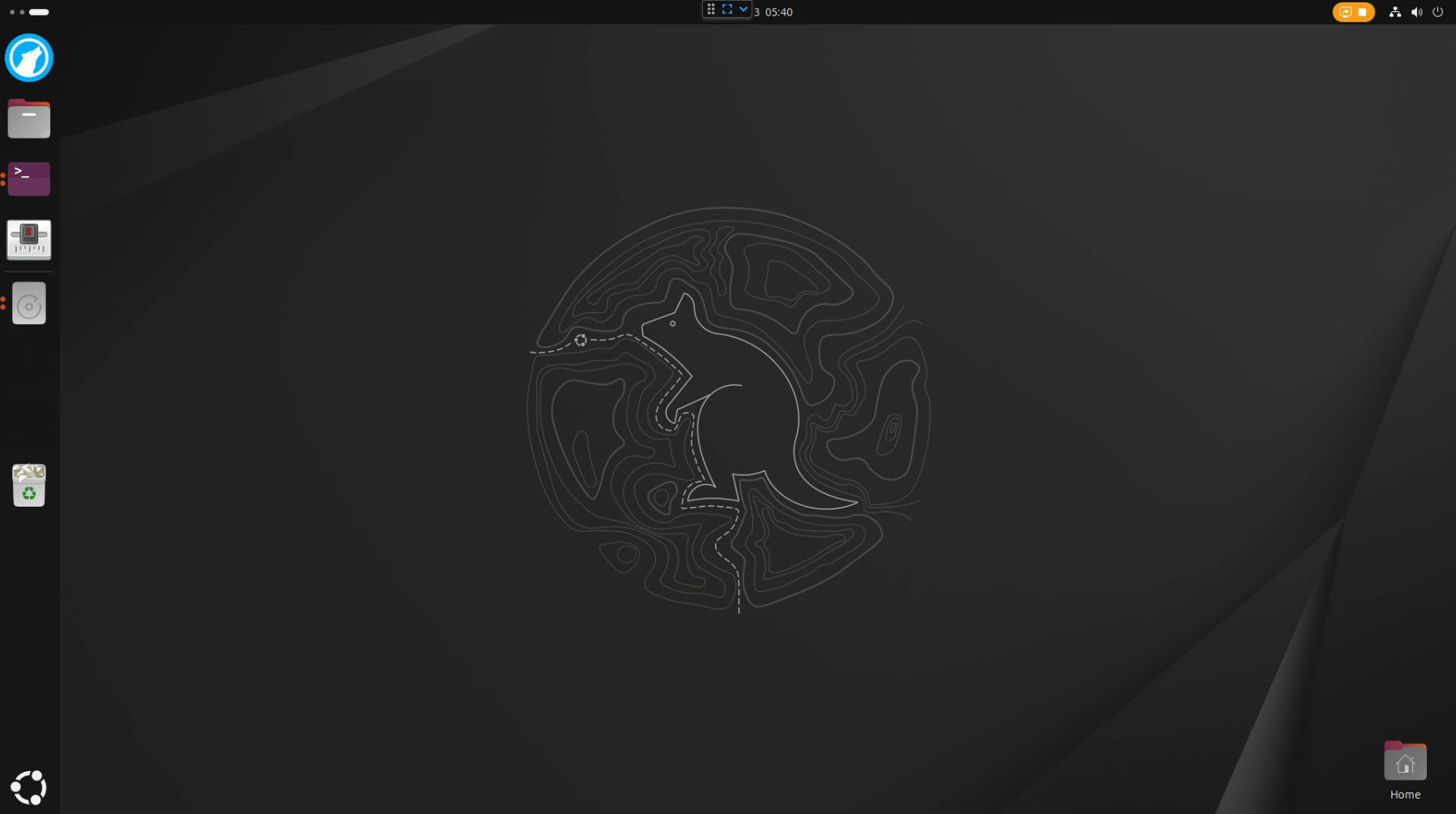
We ejected Microsoft. As we're not really in the information technology industry anymore. Microslop isn't paying my bills, so why continue to support them?
Firstly, we're not going to give you a top ten Linux OS's to try because we feel like half of those blogs were autogenerated by a fucking bot. We'll just break down the OSes that we use in 2026 right now.
The other operating systems.
Keep in mind, this is just a list of operating systems we've used. We're not rating these best/worst as every operating system has a lot of positives and negatives when you work with them.
 Debian
This is where half of the Linux community groans and calls me a basic bitch. Although this is not my first dive into Linux (that was Red Hat in the early 2000s), it was possibly my longest-running use of Linux. Because servers/VPS environments for us at least started with Debian. Raspberry Pis started with Raspbian, which is a variant of Debian. If all we were doing in servers, this is the OS we'd choose. It's solid, it comes out of the box with only the tools you need, and it's heavily documented.
 Ubuntu
When it comes to workstation use, we've switched to Ubuntu standard. Just... Ubuntu... Yes, we're aware there are variants of Ubuntu that are designed for video games or graphic design, etc., etc. This could come from our years of Debian usage. But we just want the original, unaltered, and unfucked with OS. I have found too many times that when we dived down the rabbit hole of speciality OS's, you end up running into specialty problems.
Ubuntu can be criticized for a lot of things. For starters, it's a Linux OS that does have commercialized support if you're a business that needs the company to stand behind the product. You pay out the ass for it. But it's there. Commercial support isn't selling out. It's what is needed for an OS to be accepted by businesses as a standard. Another thing that Ubuntu is criticized for is being a very heavy OS because of all that is going on. Yet, when you compare this to Microslop, that accusation to me is a bit laughable because we're only taking 1.5GB of RAM to start up the desktop versus Windows 11 pushing 4GB on startup without any external apps like Virus Checkers, utilities, etc.
We will note there's a blessing/curse of Ubuntu, which is the way you can get packages from multiple endpoints, which runs the potential of things seriously screwing up when the next kernel is released.
We've migrated our living room video station and our Mixxx DJ station over to Ubuntu. It was not a smooth transition, as audio/video bugs were still present even in version 24 of Ubuntu. But got progressively better in a matter of months.
 Void Linux
Because Ubuntu discontinued support for X86 processors, I needed something to run on my old school netbook that was rocking Intel Atom Processors. Everyone kept recommending Void Linux to me. Tried it out, it was a little rough at first (Didn't recognize my Ethernet/wireless until we broke out our USB to Ethernet adapter and updated), but after pushing some updates to it with its bizarre package manager. We're able to run a lot of modern apps (Painfully Slow) on my Netbook now, keeping old hardware alive thanks to the wonders of Void Linux.
We can certainly see why this distro gets love from the crowd that is financially strapped for any cash. It works on just about any hardware that still boots, but somehow gets thrown away. In which if you require an OS that still gets security updates for your old x86 processor. This is the one.
Workflow conversion.
This was a slow process. First, replacing my video rendering and DJ PC. I also had a 1TB Samsung drive that I could USB boot into Linux when we're trapped in hotels. Ubuntu has Steam, whose Windows executable support is getting better and better. I could still use business apps for work like TeamViewer, VLC, and, sadly, even Teams if we had to.
We would say the hardest for us is breaking away from Adobe. Destroying your Adobe workflow is like breaking a heroin addiction. We talked about FOSS alternatives a while back. But we, as human beings, are creatures of habit, and many of these companies know this. To change our workflow to another program is exceptionally hard. Harder still if a particular feature doesn't exist. Try switching to index color in GIMP and scaling/optimizing the color palette to be used for a PNG or GIF export. Kind of a pain in the ass!
Or video editing with OpenShot(Clearnet), finding out you have to convert your 4k videos to the FFV1 codec if you hope to edit them with any semblance of real-time.
But that illustrates that the grass is not greener on the other side of the OS landscape. It's filled with shit sometimes and poorly maintained because FOSS development does not have infinite financial backing like Adobe to spend years with a UX guy to make the flow of your workspace effortless.
Workflow is probably the number one reason people go back to Windows and shell out hard money every month. Because to many, this is their living, their way of life. To give up on Adobe products to them is like asking them to completely walk away from their job. And of course, you can launch Qemu to virtualize Windows just for those particular applications, which once again increases the technical knowledge of running something like Qemu and its virtualized environments, coupled with a lack of hardware accelerations, meaning that if you were working on an Adobe After Effects project, you could only software render, which is painful as fuck.
How we learned to break away from the slop is simply chipping away at it. Learning how other operating systems work. Sure, they may take longer to understand. But most Linux environments will not be eating gigs of RAM as it shoves AI down our throats. At least right now, we're rather sure someone in the tech space will make a Linux variant where AI is stupidly at the front and center. In which case, you point, laugh, and move on.
Final thoughts.

Many large corporations, after Y2K, these people considered the internet a technological failure as they couldn't immediately rip the technology out of the hands of the end user (and websites like what you are reading right now). To these companies that want to take your power and water with these data centers. They feel their project is justified because to them. They are the technological leaders that will drag society kicking and screaming into the future with A.I. Regardless, A.I. has even proven itself, if it works reliably, or if it is truly complete.
The ultimate power grab is this: you can replace the internet with an A.I. agent. Some examples.
- Need to get 32,000 cups of water from McDonald's? No problem. AI can handle that.
- Don't feel like paying for commercial AI? It's okay, you can barter with the Chipotle AI to help solve your Python scripting issue before you order that burrito.
Okay okay.. More serious:
- You don't need to go to Amazon, eBay, or Google for anything. Just speak to your A.I. Agent of choice, and they'll get anything you desire for you. Just make sure your A.I. has direct access to your bank and credit card accounts, as you bet your ass there will be a surcharge for the use of services in the future. Shittification knows no boundaries.
- Do you need to opt out of a certain service? A.I. should help you with this. But this is probably the point where A.I. will hallucinate and instead put you down for another 1-5 years of that streaming service you want to opt out of and mark it premium.
- You don't need to know anything about computers. That's what A.I. is for.
This is counterintuitive to getting better and learning about computers. This is dumbing down technology to its lowest common denominator to make it depend 100s of times worse than the Adobe workflow.
You have a modern business that desperately wants to destroy modern workforces with AI. Because of their own corrosive ways of running a shit business and making shit customers. It's no wonder why they don't want to listen to their support team reporting how shitty things are. It's better to just fire your support team and let AI take over. In fact, let your production have AI run it.
Eventually, you look at movies like "The Terminator" differently. In that movie " Where Jesus Complex, John Conner wasn't really saving humanity from Skynet." Everyone knew what SkyNet did and simply didn't care as long as it made them more money than humanly fathomable. When AI comes around to start geeking people for running out of money. It's humanity in the hands of a few begging Skynet to do it.
This is why many people reject A.I., setting aside the notion that we aren't anywhere near wide-band A.I. Technology like what is shown in the movie Terminator. It really comes down to ownership. Who owns the black box that the neural computing is sitting on? When you trace it to people like Sam Altman, who feel his datacenters deserve more priority than a child when it comes to necessities like water. Is that really not the kind of guy you want guiding the hand of tomorrow?
Shit... Fell off track.
I guess the real thought of this article is this. It's okay to get mad. Don't let it eat you alive. Don't let your anger be exploited either. That's how the elderly fall into the trap of watching News Show TV Commentary. Do something about it. It might be hard at first. But over time, you'll feel better about the decisions you've made. Microslop wanted to eat all of my RAM, use all of my computing cycles to turn an OS into a surveillance weapon against me. Fuck you, Microslop, we know where that eject button is. We're aware you're willing to do anything possible to rip that button away, too. Game on bitch.
That's what server said.
+++END OF LINE